VC-A Video Podcasts

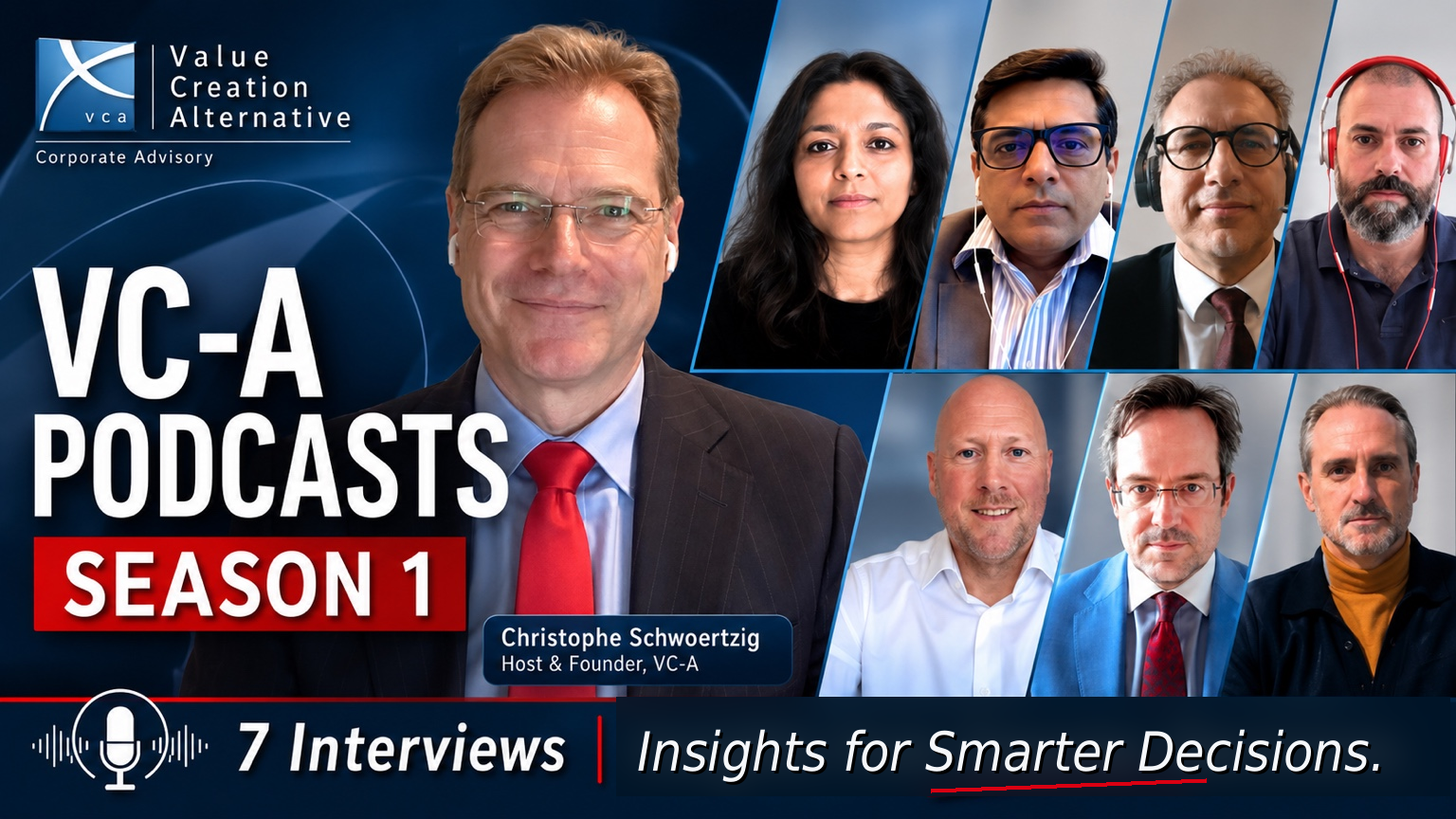
Watch Value Creation - Alternative video podcasts covering corporate advisory, M&A, fundraising, alternative finance, AI adoption, and business development.

Open Source AI: The Hidden Infrastructure Behind European AI Adoption

Play

Podcast Synopsis

Speaker: Michael Berns
Company: Eclipse Foundation, VC-A Member
Role: Head of AI, Eclipse Foundation
Recorded: 19 June 2026

Bio: Michael Berns is Head of AI at the Eclipse Foundation, a non-profit, vendor-neutral open source foundation headquartered in Brussels. He has more than 13 years of applied AI experience across financial services, regulation and enterprise transformation, including seven years as Director of AI at PwC Germany and earlier roles with Digital Reasoning, Morgan Stanley / MSCI Barra, Moody’s Analytics and Wolters Kluwer.

Executive Summary

Michael Berns joins Christophe Schwoertzig to discuss the layer beneath AI adoption: open source AI infrastructure, vendor neutrality, governance, procurement risk and European technology sovereignty. The conversation explores why enterprises should not only ask how to adopt AI, but also where the AI they adopt comes from, who controls it, how transparent it is, and whether Europe can build trusted, auditable and commercially relevant AI infrastructure of its own.

  • Open source AI is becoming a strategic issue. Michael explains why it is no longer only a developer topic, but increasingly a procurement, governance, investment and sovereignty question for enterprises, boards and regulated sectors.
  • Vendor neutrality matters for AI procurement. Foundation-hosted open source projects can reduce concentration risk, improve transparency and help enterprises avoid excessive dependence on a single vendor, API, pricing model or geopolitical context.
  • Open weights are not the same as open source AI. Michael clarifies why true open source AI requires more than access to model parameters, and why auditability depends on transparency around training, evaluation, methodology and governance.
  • Cross-pollination happens at the infrastructure layer. Through examples such as Eclipse Open VSX and software-defined vehicles, the discussion shows how competitors can collaborate on shared standards and infrastructure while still competing commercially.
  • Open source can be a commercial wedge for startups. Rather than giving everything away, founders can open source the protocol, runtime or foundational layer while keeping enterprise features, services and commercial differentiation proprietary.
  • European AI policy will shape the market. The EU AI Act, Cyber Resilience Act, G7 discussions and UN-level policy work are making AI governance an operational issue for investors, advisers, enterprise leaders and M&A professionals.

Beyond Bali: Finding the Missing Piece in South Lombok

Play

Podcast Synopsis

Speaker: Oliver Thirlwall
Company: Altai Land, VC-A Member
Role: Founder, Altai Land
Recorded: 09 June 2026

Bio: Oliver Thirlwall is a real estate finance and development professional with experience across Asia, including roles in real estate finance with Merrill Lynch and several years in Mongolia. Through Altai Land, he focuses on land development in Lombok, Indonesia, where his current project involves a large coastal peninsula on South Lombok’s emerging tourism corridor.

Executive Summary

Oliver Thirlwall joins Christophe Schwoertzig to discuss Altai Land’s South Lombok development opportunity and why Lombok may represent one of Indonesia’s most interesting emerging tourism and hospitality markets. The conversation explores Lombok’s positioning beyond Bali, the strategic importance of Mandalika, the role of infrastructure and international flights, and the potential to turn a rare coastal landholding into a managed resort estate ecosystem.

  • South Lombok is still early in its development cycle. Oliver explains why Lombok combines natural beauty, surf tourism, airport access, and improving infrastructure with a market that remains far less mature than Bali.
  • The missing piece is international connectivity. Direct international flights, especially from major markets such as Australia, could materially accelerate tourism growth and property absorption.
  • Mandalika creates a strategic anchor. The project benefits from proximity to a government-backed tourism zone, better infrastructure, planned development, and the potential for South Lombok to become the island’s premium area.
  • The peninsula is difficult to replicate. Large, centrally located coastal landholdings are scarce, and this site was assembled over many years through more than one hundred separate land titles.
  • The opportunity is broader than land sales. The project could evolve into a managed villa community, branded residence concept, hospitality platform, and recurring estate management business.
  • Proper diligence remains essential. Title, zoning, master planning, development costs, financing structure, legal assumptions and execution risks must be verified before the project becomes fully investment-ready.

Institutional Tokenization: Beyond the Asset Layer

Play

Podcast Synopsis

Speaker: Gaya Chandrasekaran
Company: Independent Advisor and Researcher, VC-A Member
Role: Institutional Tokenization and Financial Market Infrastructure Specialist
Recorded: 28 May 2026

Bio: Gaya Chandrasekaran has over 17 years of experience across corporate banking, investment banking, and wholesale credit risk within global financial institutions. Her career combines front-office commercial deal-making with senior executive risk management, giving her a deep institutional perspective across capital markets, liquidity, regulation, and financial infrastructure.

Executive Summary

Gaya Chandrasekaran joins Christophe Schwoertzig to discuss why tokenization should not be understood merely as the digital representation of financial assets. The conversation reframes tokenization as a much deeper transformation of financial market infrastructure, where settlement, custody, compliance, liquidity, risk management, and governance need to operate together within more integrated and programmable environments.

  • Tokenization is an infrastructure transition, not just a product innovation. Creating a tokenized bond, fund, equity, or loan is no longer the main challenge; the real issue is whether those assets can function within institutional systems of settlement, custody, liquidity, compliance, and governance.
  • The market remains too focused on the asset layer. Many pilots have created digital versions of traditional assets without solving the surrounding infrastructure problem, resulting in parallel complexity rather than true institutional scalability.
  • Regulation is not necessarily the bottleneck. Gaya argues that regulation often reveals whether the underlying architecture is mature enough to operate safely at scale, with compliance, reporting, risk controls, and governance embedded into the system itself.
  • Faster settlement does not eliminate financial risk. Atomic settlement may reduce counterparty exposure, but it can also increase liquidity and collateral demands, showing that technology cannot bypass the fundamental laws of capital markets.
  • Successful adoption will be hybrid, programmable, and institutionally coordinated. The future of tokenization will depend on interoperability, common standards, unified ledgers, programmable compliance, collateral mobility, and the ability to connect new digital infrastructure with the systems institutions already rely on.

Building Ventures Through Ecosystems, Not Just Capital

Play

Podcast Synopsis

Speaker: Ayan Desai
Company: Nalanda Capital Partners, VC-A Member
Role: Co-Founder & Director
Recorded: 28 April 2026

Bio: Ayan Desai is a venture builder and alternative investment professional with more than two decades of experience across international capital markets, fund management, private equity, venture capital, and real estate. Through Nalanda Capital Partners, he focuses on building and scaling ventures through a combination of strategic partnerships, commercial structuring, market development, risk mitigation, and long-term capital.

Executive Summary

Ayan Desai, Co-Founder and Director of Nalanda Capital Partners, shares how Nalanda is building an ecosystem-driven investment platform designed to scale ventures through more than funding. The conversation explores the logic behind Nalanda’s network model, its focus on digitalisation, decarbonisation and deglobalisation, and the benefits of applying cross-sector learning across ventures such as Luminis, Regalia and Cultyvate.

  • Nalanda is built around more than capital. Nalanda’s model goes beyond financing. It aims to support ventures through market development, commercial development, risk mitigation, and eventually capital and exit.
  • The platform is organised as an ecosystem. Ayan explains that many promising ventures fail when sectors operate in silos. Nalanda’s answer is to bring greater coherency between business leaders, founders, innovators, and long-term capital.
  • The strategy is anchored around three structural themes. Nalanda’s philosophy is built around digitalisation, decarbonisation, and deglobalisation, with a focus on scalable solutions linked to innovation, connectivity, and waste management.
  • Multi-sector investing can create operational cross-learning. Rather than treating sectors as isolated, Nalanda looks for common operational patterns across agriculture, energy, transportation, and related ecosystems. Ayan highlights how insights from one sector can become useful baselines for another.
  • The real differentiator is solving the client’s problem deeply. For Ayan, what makes a venture strategic is not the idea alone, but the ability to understand how deep the client’s problem is, how long it has existed, and how to build an outcome-based solution that is commercially viable.

Unraveling Fraud: Credibility and Governance Issues

Play

Podcast Synopsis

Speaker: Giuseppe Bianco
Company: Deutsche Börse Group
Role: Internal Control System Expert, Deutsche Börse Group, VC-A Member
Recorded: 17 April 2026

Bio: Internal control and governance professional with nearly 20 years of international experience across financial markets, having worked in Milan, Dublin, London, and Luxembourg. Giuseppe is also Adjunct Lecturer at Université de Lorraine, completing the Global Executive MBA at IESE Business School.

Executive Summary

In this episode, Giuseppe Bianco joins Christophe Schwoertzig to discuss why major frauds and corporate failures keep repeating despite stronger regulation, better systems, and more data. Drawing on Madoff, Wirecard, Theranos, and FTX, the conversation shows how credibility, complexity, incentives, and powerful narratives can reduce scrutiny and delay action. The central message is clear: many failures are not caused by lack of information, but by failures of judgment, escalation, and governance.

  • Fraud often starts with credibility, not deception. Strong reputations, prestigious investors, listed status, or compelling narratives can reduce scrutiny precisely when scrutiny should increase.
  • Warning signs are often visible but not escalated. In many major failures, the problem is not that signals were absent. The problem is that concerns were rationalised, delayed, or not pushed to resolution.
  • Narrative must never replace evidence. Cases such as Theranos show how powerful stories, media attention, and high-profile backers can obscure the absence of verifiable reality independently.
  • Front-end discipline is a governance filter. KYC, proof of funds, proof of product, ownership checks, NDAs, and structured onboarding are not administrative formalities. They help filter weak or misleading counterparties early.
  • Never outsource judgment to credibility. Credibility may open the door, but only independent verification should determine whether boards, investors, advisors, and leaders should walk through it.

How AI Adoption Becomes Institutional Advantage

Play

Podcast Synopsis

Speaker: Magnus Jern
Company: xHuman Labs
Role: Co-Founder & COO, xHuman Labs | VC-A CTO for AI Adoption
Recorded: 20 April 2026

Bio: Serial entrepreneur, former Golden Gekko CEO, and technology operator with seven co-founded companies, four exits, and 35 years of software development experience. Magnus combines deep technical expertise with hands-on experience in scaling digital businesses, AI adoption, and enterprise transformation.

Executive Summary

Magnus Jern joins Christophe Schwoertzig to discuss what it really takes to succeed with AI in business. From shadow AI and messy data to undocumented workflows and the path toward autonomous agents, the conversation shows why AI success depends less on hype and more on collaboration, structure, security, and execution. Magnus also explains why AI adoption must move beyond experimentation: successful transformation requires leadership alignment, data readiness, governance, and the ability to turn working pilots into scalable business value.

  • AI adoption is a leadership challenge before it is a technology challenge. Success depends on management, process, data, collaboration, and security — not just on buying LLM licenses.
  • Companies must move from individual AI use to shared organisational capability. Isolated “power users” are not enough; real value comes when teams collaborate, share prompts, workflows, and learnings.
  • Shadow AI should be managed, not just banned. It creates risk, but it also reveals where employees are trying to solve real problems faster than the organisation allows.
  • You do not need perfect data to start. SMEs can begin with selected high-value documents and context, then build gradually instead of waiting for a flawless data infrastructure.
  • The foundation for AI is documented workflows. Before chasing autonomous agents, companies should identify, map, and improve the repetitive processes where AI can deliver immediate business value.

How Value Creation - Alternative Creates Value

Play

Podcast Synopsis

Speaker: Christophe Schwoertzig
Company: Value Creation - Alternative
Role: VC-A Founder and Managing Director
Recorded: 05 November 2025

Bio: Founder of VC-A, strategy and investment advisory professional, and former IT engineer. Christophe helps companies accelerate growth by combining cross-pollination, capital access, M&A, AI adoption, and VC-A’s global ecosystem of experts, investors, and solution providers.

Executive Summary

In this episode, Christophe Schwoertzig explains how Value Creation - Alternative helps companies find the “missing piece” needed to unlock growth. The discussion introduces VC-A’s ecosystem-driven approach, combining strategy, M&A, fundraising, AI adoption, business development, and cross-border execution. A central theme is cross-pollination: transferring ideas, solutions, and opportunities across sectors, geographies, and cultures to uncover growth potential hidden in the “unknown unknowns” space. VC-A’s objective is to help companies grow faster, safer, and smarter through structured execution and a compliance-first approach.

  • Value creation starts by finding the missing piece. VC-A helps companies identify the capability, partner, investor, technology, transaction, or strategic angle that can unlock their next stage of growth.
  • Cross-pollination reveals hidden opportunities. Ideas that are ordinary in one sector, geography, or culture can become highly valuable when transferred to another context.
  • The biggest opportunities often sit in the “unknown unknowns” space. Companies tend to search within familiar boundaries. VC-A helps reveal opportunities that are outside the client’s immediate field of vision.
  • VC-A combines advisory with execution. VC-A brings together strategy, M&A, fundraising, AI adoption, business development, and cross-border capabilities through a structured ecosystem.
  • Growth must be faster, safer, and smarter. VC-A focuses on tangible value creation while applying disciplined processes, counterparty selection, and a compliance-first approach.
Volver arriba