


Most growth strategies are built on what leaders can already see.
They start with the familiar questions:
Where can we expand? Which adjacent products should we launch? Which competitors should we acquire? Which investors might fund us?
That’s sensible—until it isn’t.
Because the biggest value-creation moves often come from a different place: not from the “known” opportunities you can name, but from the opportunities you don’t even know exist yet.
In other words: the unknown-unknowns.
The real growth frontier: the unknown-unknown box
You may know the classic matrix:
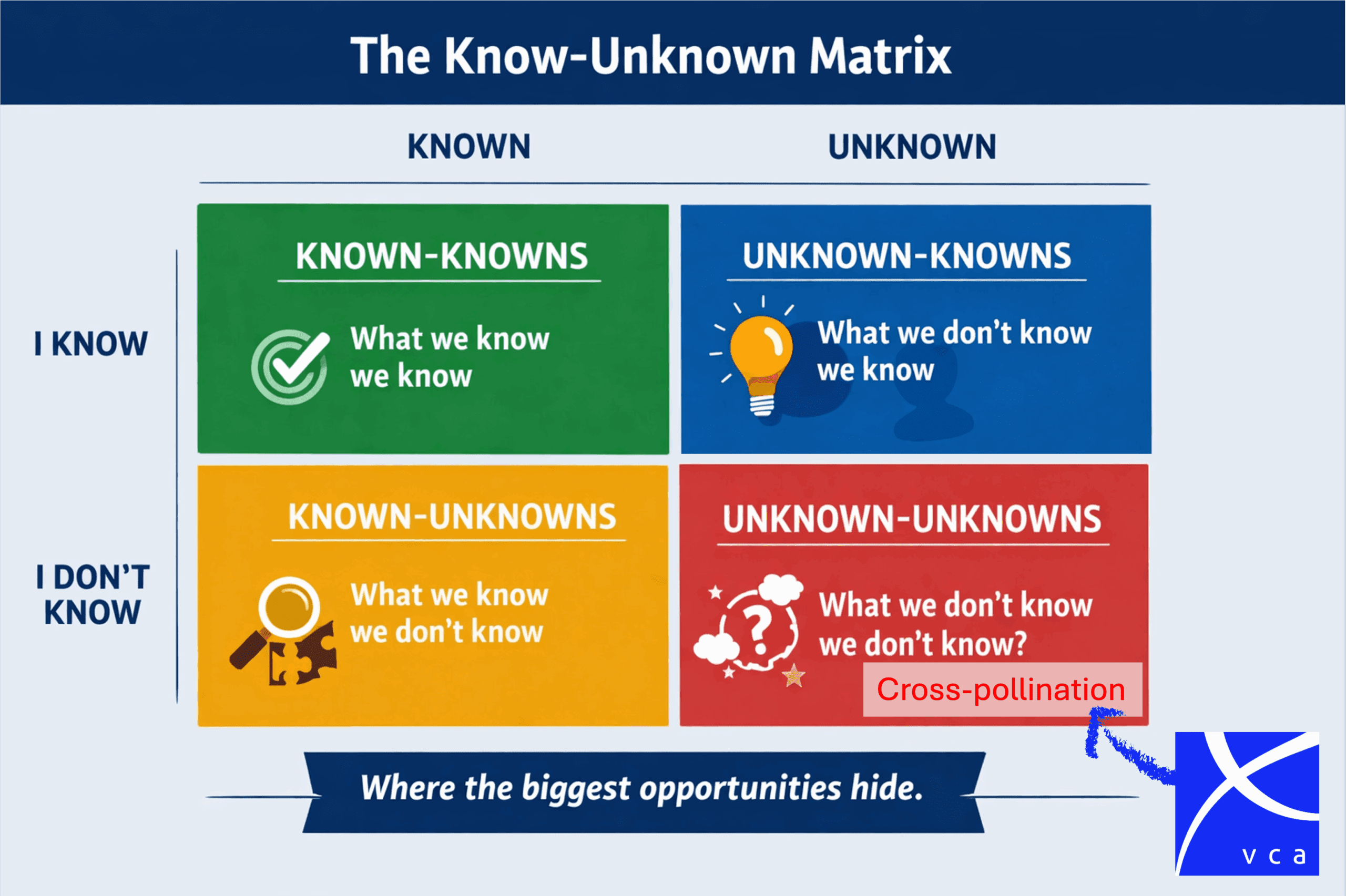
- Known-knowns: what we know we know (core strengths, current markets, reliable levers).
- Known-unknowns: what we know we don’t know (skills gaps, missing capabilities, clear information needs).
- Unknown-knowns: what we know but don’t actively use (underleveraged assets, dormant relationships).
- Unknown-unknowns: what we don’t know we don’t know (blind spots, unimagined partnerships, unseen deal structures).
Most organisations are reasonably good at the first two boxes. They run plans, hire experts, commission reports, and close capability gaps.
The unknown-knowns can offer business enhancement opportunities such as cross-selling, up-selling, improved customer retention and maximising returns on assets.
But the unknown-unknown box is where step-change growth hides—and where traditional advisory models underperform.
Why? Because you can’t Google what you can’t name. You can’t run a standard RFP for something you haven’t conceptualised. And you can’t source a partner you don’t realise is relevant.
Why cross-pollination works when linear sourcing fails
When teams search for growth opportunities, they often search linearly:
- within their sector,
- within their geography,
- within familiar deal formats,
- within known investor categories,
- within established supplier ecosystems.
This approach is efficient and comfortable — but it’s biased.
It systematically overlooks the types of opportunities that only emerge when you connect distant dots:
- a capability from one industry that unlocks a new unit economics model in another,
- a financing structure used in one jurisdiction that solves a constraint elsewhere,
- a partnership archetype from a different value chain that accelerates market entry,
- an AI or data asset that becomes a distribution wedge when paired with the right operator,
- an overlooked relationship that becomes strategic when reframed through a different lens.
That is what we mean by cross-pollination: the intentional transfer of ideas, capabilities, and counterparties across sectors, functions and borders to surface new value creation paths.
VC-A’s mission: uncover the missing piece
At VC-A, we operate on a simple belief:
Growth is often a “missing piece” problem.
Not “work harder” or “spend more on marketing.” But:
- the missing partner,
- the missing capability,
- the missing structure,
- the missing capital source,
- the missing positioning,
- the missing route to market.
And the missing piece is frequently not visible from inside one industry’s logic.
So VC-A is designed as a cross-pollination engine:
VC-A uncovers unknown-unknown growth opportunities through cross-pollination—connecting capital, partners, and capabilities across borders and sectors to find the missing piece.
How it works in practice (without the buzzwords)
Cross-pollination is not networking for networking’s sake. It is a disciplined method with three outputs:
Importantly, this is not just a mindset: VC-A operationalises cross-pollination through its ecosystem of operators and investors, supported by structured workflows and deal intelligence—so ideas move quickly from insight to execution.
1. Reframing the problem (the “why are we stuck?” diagnosis)
Often, the visible constraint is not the real constraint.
Example patterns we see repeatedly:
- “We need capital” → actually, you need a structure that makes capital comfortable.
- “We need leads” → actually, you need a distribution partner with trust and reach.
- “We need AI” → actually, you need data governance and operating adoption before tools help.
- “We need to grow internationally” → actually, you need a local champion and the right deal shape.
The first cross-pollination step is conceptual: reframing the challenge so the solution space expands.
2. Expanding the solution space (the “who/what else could solve this?” phase)
Once reframed, we purposely look outside the obvious peer group:
- different industries with similar constraints,
- different geographies with different market mechanics,
- different investor types with different risk appetites,
- different deal structures and governance models.
This is where “unknown-unknowns” begin to become “known-unknowns”—and then executable.
To make this tangible, here are two real patterns we’ve seen when connecting distant dots:
1) Big Data: monetising data as an asset (not a cost centre)
In one case, a company saw “data” mainly as an IT and compliance topic. Cross-pollination changed the frame: we applied financial structuring logic typically used for artwork monetisation—where an illiquid, hard-to-price asset can be valued, insured, and capitalised—to rethink data as a capex. The result was a new pathway to unlock value: moving from “we generate data” to “we capitalise data”—with clearer governance, improved investor narrative, and more strategic options to monetise the said data.
2) Hospitality: assessing the intangible value of hotels with AI
Hotels are often valued around tangible KPIs and future cash flows. Cross-pollination introduced a different lens: we borrowed digital marketing methodologies used in e-commerce—where brand, market sentiments and events, third-party infrastructures and conversion economics drive intangible value—and applied them to hospitality. Combined with AI, this approach helps quantify and explain intangible drivers (brand strength, players' sentiments, efficiency, digital demand, pricing power), improving strategic decision-making, investment positioning and portfolio monitoring.
3. Converting insight into execution (the “make it bankable” phase)
An idea is not a project.
Execution requires:
- the right counterparty,
- disciplined follow-up and coordination,
- credible investor messaging,
- robust documentation and due diligence readiness,
- governance and compliance, where applicable.
The cross-pollination insight must be converted into an actionable pathway: mandate scope, target list, investor list, partnership architecture, timeline, and documentation.
That’s the difference between “interesting connections” and real value creation.
Why investors should care: better asymmetry, better optionality
From an investor’s perspective, the VC-A model is designed to produce two advantages:
Better asymmetry
Unknown-unknown opportunities are, by definition, under-discovered. That means:
- fewer bidders,
- less pricing pressure,
- more ability to shape structure,
- more room for value creation beyond multiple expansion.
Better optionality
Cross-pollination tends to generate multiple paths:
- JV vs acquisition,
- minority growth investment vs structured financing,
- partnership-led market entry vs build-out,
- carve-out vs platform roll-up.
Optionality is not indecision—it is strategic leverage.
VC-A is not a universal fit.
VC-A is selective by design. Cross-pollination only creates value when leadership is willing to challenge assumptions, look beyond familiar sector playbooks, and follow through with decisive execution. Organisations anchored in the comfort of what is already known—whether due to overconfidence, change fatigue, risk aversion, competing priorities, or limited bandwidth—typically won’t benefit from our approach. In those cases, we prefer to decline early, protecting focus and standards for our members and investors. VC-A works best with intellectually humble, open-minded leaders who have both the appetite and the capacity to pursue “unknown-unknown” opportunities.
The new standard: ecosystems outperform silos
Markets increasingly reward organisations that can:
- move across sectors,
- combine capabilities quickly,
- build coalitions,
- structure capital creatively,
- and execute cross-border.
Siloed models—whether purely consulting, purely broking, or purely “deal flow”—struggle to keep up.
The future belongs to ecosystems that can discover and assemble the missing pieces at speed.
That is what VC-A exists to do.
Closing thought
Most people think growth is about having more answers.
In reality, the highest value creation often comes from asking better questions—especially the ones you didn’t know to ask.
If you want to explore where the “unknown-unknowns” might be hiding in your business or investment thesis, VC-A is built for that search.
VC-A uncovers unknown-unknown growth opportunities through cross-pollination—connecting capital, partners, and capabilities across borders and sectors to find the missing piece.
Interested in collaborating or co-investing in a VC-A project?
Get in touch to discuss your focus (sector, geography, ticket size, and preferred deal structures) and we’ll share the 1-3 relevant opportunities and the rationale behind them.
