


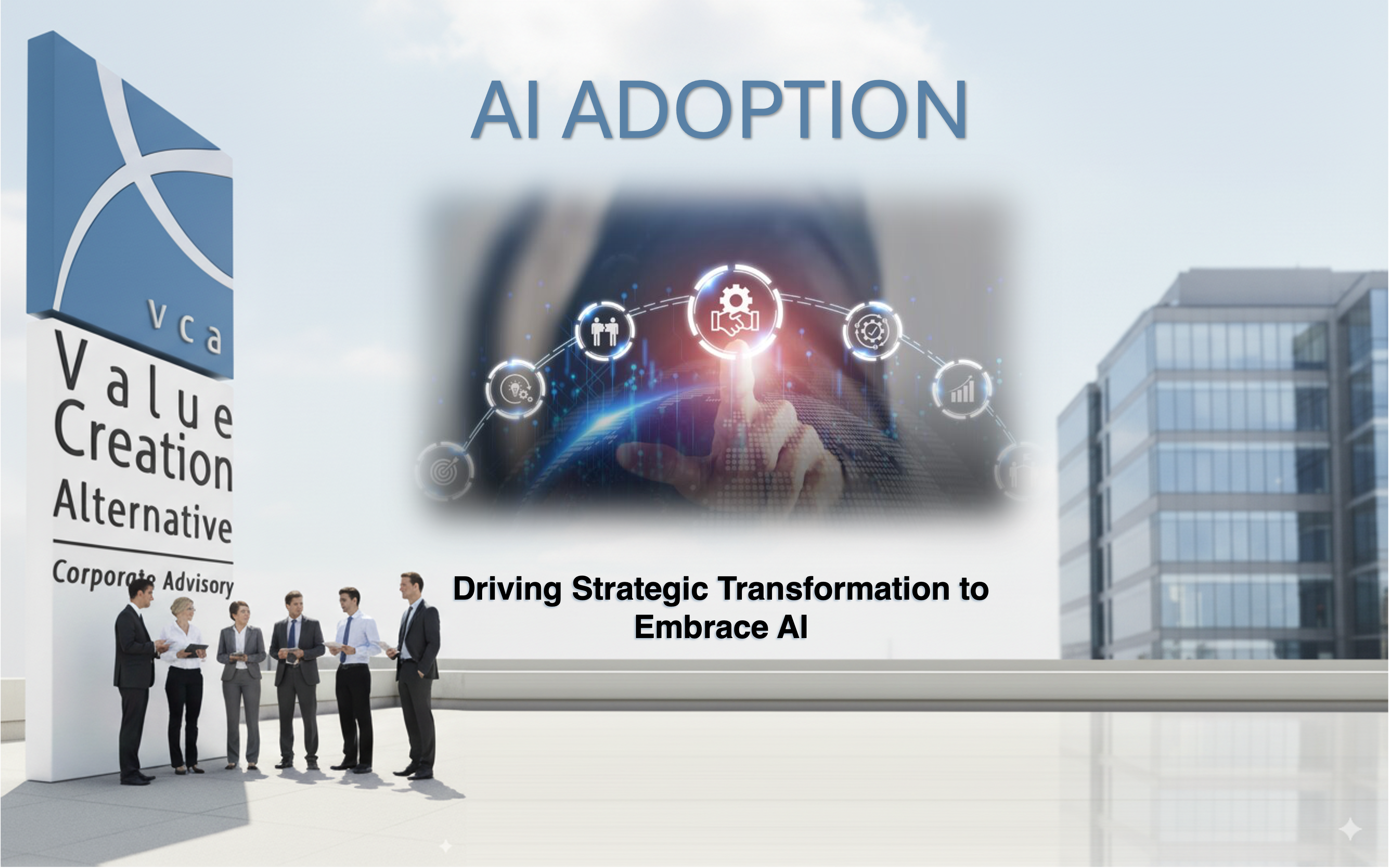
AI-Adoption Program - Key Service Objectives
Uncertainty around AI adoption is sky high. A recent MIT/Fortune report highlights that 95% of corporate generative AI pilots fail before scaling. The reasons are clear: lack of alignment, poor business models, and projects driven by hype rather than strategy.
At Value Creation – Alternative, we believe AI should not only reduce costs but also create new revenue streams to offset implementation costs. Think of the gold rush: most who searched for gold failed, but those who sold the tools built fortunes. Deploying AI only for internal optimisation is “digging for gold.” By reusing and monetising AI capabilities through corporate venturing or data optimisation, your company can become the one “selling tools.”
That’s exactly what our AI-Adoption Program delivers: a structured, compliance-first approach to design pilots, scale what works, and spin off new ventures.
We have structured the program into 12 key steps, typically rolled out over the course of a year.
1. Demystify Artificial Intelligence
Provide a clear overview of what AI truly is, how it works, demystify some of the AI jargon and acronyms, and clarify where the current state of technology lies versus the surrounding hype. This session equips participants with foundational technical understanding of LLMs, RAG and their practical implications, enabling informed decision-making throughout the AI adoption journey.
2. Secure CxO Buy-In and Strategic Alignment
Address the common failure of delegating AI initiatives solely to IT departments. Learn how to craft persuasive, business-oriented messaging that resonates with executive stakeholders and secures their commitment to the transformation program from the outset.
3. Assess Impact and Anticipate Resistance
Identify the functional areas most affected by AI and anticipate common barriers to adoption. This session examines workforce implications (reskilling, layoffs, outsourcing), organizational resistance, and strategic dilemmas such as in-house development vs. external solutions.
4. Align AI with Strategic Vision
Position AI as a driver of long-term competitiveness in a VUCA world. Explore how to embed AI within the company’s strategic roadmap and develop data-centric business models by rethinking data governance, architecture, and lifecycle management.
5. Reinforce Business Fundamentals
Ensure the organisation’s value proposition, business model, and operational backbone are solid before adopting AI. Review key frameworks (Porter’s Value Chain, SWOT, BCG Matrix, VRIO) to assess competitive advantage and readiness for transformation.
6. Set Key Objectives
Move beyond traditional KPIs to adopt agile metrics not always measurable suited for AI projects. Introduce OKRs (Objectives & Key Results) and distinguish between process automation and process obliteration. Special attention is given to managing IT, HR, Finance, and Compliance – the “four horsemen of AI-Pocalypse”.
7. Build Empowered, Cross-Functional Teams
Form multidisciplinary teams with clear mandates and measurable goals. Foster a culture of experimentation, learn fast – fail fast, and internal competition focused on non-financial KPIs. This session outlines how to ring-fence budgets, support team autonomy, protect the losers, promote knowledge sharing and success recognition.
8. Design and Launch Strategic Pilots
Apply ambidextrous leadership principles to design pilot initiatives aligned with core business and innovation strategies. Participants will learn to use structured business modeling frameworks to assess feasibility, risks, and fit within broader organisational goals.
9. Deploy Through Controlled Rollouts
Implement AI pilots progressively across regions, business units, or functions to reduce risk and optimise learning. This session covers techniques for identifying resistance, ensuring replicability, and building scalable frameworks for broader adoption.
10. Spin Off Successful Initiatives
Learn how to turn AI pilots into standalone ventures or internal growth engines. Evaluate models such as corporate venturing, MBOs, internal incubators, or innovation labs, with a focus on data-driven IP monetisation.
11. Scale Successful Models Organisation-Wide
Understand how to transition from pilot to enterprise-scale deployment. This session focuses on measuring cross-unit effectiveness, refining what works, and recognizing when to recalibrate or restart based on technological obsolescence or market shifts.
12. Leverage AI for New Business Development
Explore AI’s potential to drive revenue, not just reduce cost. Discover strategies to create new product lines or business models powered by AI and assess funding options—from internal budgets and public aids to PIFs, AIFs, UCITS, IPOs or SPACs.
🤝 Call to Action
Interested in learning more about our approach and how you could leverage the VC-A network to achieve your goals?
Please share your budget range and request for quote (RFQ), and we will assess how best we can meet your expectations.

VC-A’s AI Adoption – Value Proposition
I am thrilled to officially launch VC-A's new AI-Adoption program. The VC-A AI-Adoption program is our value proposition to help corporates and public institutions embrace AI. This presentation is intended exclusively for VC-A Members and is not meant to serve as a business proposal for prospective clients. The video is 12 minutes long and offers...
